Wednesday, July 20, 2011

Desert Life


“Strolling on, it seems to me that the strangeness and wonder of existence are emphasized here, in the desert, by the comparative sparsity of the flora and fauna: life not crowded upon life as in other places but scattered abroad in spareness and simplicity, with a generous gift of space for each herb and bush and tree, each stem of grass, so that the living organism stands out bold and brave and vivid against the lifeless sand and barren rock. The extreme clarity of the desert light is equaled by the extreme individuation of desert life-forms." - Edward Abbey

Swinging into the sunset
I have always been fascinated by desert environments & I think Abbey sums it up well in his description of the desert's simplicity.  Hiking in the desert brings a person back to this beautiful simplicity.  Being exposed to the elements you rise with the sun to take advantage of the cool morning air and follow your instincts from there..... Hiking in the stillness it seems as though the world is either at macro or micro scale and our human scale is close to non-existent to the world around us - we are only an observer.  The macro scale is in the vast open spaces - seeing for miles away and gazing at massive geological wonders.  The micro scale is beneath our feet - all of the creatures have adapted to be small and/or camouflaged and the true treasures such as ancient tiny seashells stand out like diamonds amongst the red sand.  Sometimes it is not cool water, shade or the music of a busy life that is the most refreshing - Instead, it is the thirst, the dry heat and only the sounds of our footsteps and heartbeat that bring us back to life.

Lounging Ibex
Early morning start for the desert hike...
Stairs up the canyon wall


looking out from one of the caves along the cliff that monks used to dwell in
     

The group of classmates and friends that we stayed with in Sde Boker - a small university community within the Negev

Bedouin Tent
         A note about the Bedouin of the Negev.... The term 'Bedouin' literally means desert dweller in Arabic and continues to represent the last group of nomads in the region.  The Negev desert is estimated to be home to around 150,000 Bedouins, most of which live in 'unrecognized' villages.  The Bedouin encampments seem to be just another trouble on the Israeli government's long list.  The government has passed laws restricting the Bedouins nomadic lifestyle by not permitting grazing and establishing private ownership and borders to the seemingly desolate terrain. The goats were their major source of livelihood and without their herds they lack the goat hair to weave their rugs and tents as well as food for their families.  Now the encampments are comprised of everything and anything they can find from pieces of plastic to old lumber. The government has also attempted to resettle the Bedouins into constructed 'legal' towns (many times by bulldozing their seemingly temporary establishments) - but a circle of buildings does not make a community and with no business or economy the Bedouins are struggling and the towns are failing.  Many Bedouins in 'unrecognized' encampments have begun small tourist initiatives by providing tea and pita to passing travelers (such as the tent seen in the pictures).

Relaxin' in the Bedouin tent

Wednesday, July 13, 2011

Sweet Water


The consistent wind is the only relief from the hot furnace of the day
    The question of fresh water, also known as 'sweet water' in Israel, has become my ticket into the lives of many people around me and the lens through which I view their personal stories of passion, fear, hatred, love, exhaustion & hope.  I recently traveled to a small village outside of Jericho, one of the world's oldest cities, to hear personal stories & see how steps towards peace and sustainability could be made through water.


    It has become increasingly evident that the government (on both sides)  has continued to foster distrust and obstructed many of the possibilities for cooperation as they are caught up in conflict and inaction.  However, where governments are failing, civil-society is standing up to give a voice to the degrading environment and the social stress that is deeply rooted in the health of the natural world around them.  The water scarcity issues are inherently transboundary and as civil-society comes to the forefront, cooperation is emerging and sustainable solutions are giving hope.

    One of the groups that has survived the test of time and conflict in the area is Friends of the Earth Middle East (FOEME).  FOEME remains one of the only joint Israeli-Palestinian organizations engaged in transboundary water issues.  'Joint' is the key word here - for it is extremely uncommon!  In order to work with one another you have to recognize the existence of the 'other'.  In most cases, even seemingly contemporary and sincere environmental and social NGO's refuse to work jointly - with the perspective that they are not against the other side but not exactly for the other side either.
    So, knowing a bit of background on FOEME I decided to seek out a way to connect with them and see how they overcome tense political agendas with environmental education and transboundary cooperation. Long story short, I decided the best introduction for me would be to visit one of their new 'Eco-Centers' that was located in Auja, just north of Jericho (also known as West Bank's 'Area B').
    Myself and two friends (Dan & Eric) arrived to Auja in the heat of the day (which meant between 8am and 5pm here); dripping in sweat we were warmly greeted by the contacts I had made at the center and then told nothing could be done/discussed until  it cooled down - which was fine by me as a siesta was calling my name.

Auja Eco-Center
    As the sun was beginning to set we were first given a tour of the Eco-Center grounds.  The area was colorfully decorated with recycled tires to form pathways, lounging areas, and a playground.  The best part about the center was its grey-water system which was made up of a series of open plastic containers filled with an assortment of rocks, plants and sand of which the water from the center (from showers, kitchen/bathroom sinks etc) is filtered through and then used to water the small gardens.

Grey-water system
     After the center tour, our guide Mohanned led us through the neighborhoods and into the surrounding farmland.  It was a treat to have Mohanned because he had grown up in Auja (a small village of around 5,000) and knew pretty much everyone.  He has 15 siblings and over 60 cousins in Auja so not only did he know everyone - almost everyone we met was his cousin, so every story he told was a personal family story.  
    I will try and sum up the water situation in Auja as brief as possible from the perspective given to us by those that live there.  Auja is located in the Jordan Valley which was once known for being full of springs and very fertile. Mohanned reflected on his time growing up when the fields were full of banana trees and date palms - a bountiful time for the Jordan Valley.   Unfortunately the picture now is the extreme opposite with no water in sight and only dust in the fields.  The lack of water can be primarily attributed to two factors - 1. An extended drought period & 2. The water usage of recently established Jewish settlements. 
    The primary water source for Auja is the groundwater which provides flow for local wells and springs.  Surface water is pretty much nonexistent because the Palestinians have been denied access to the Jordan River (about 4 km away) since 1967. Although it should also be noted that even if there was access to the Jordan river, it would not sufficiently provide for the communities needs because it is more of a toxic stream - having lost more than 90% of its normal flow in the last five decades it has been used and abused. *side note* The river is fenced off so you can't even see it on the Palestinian side.  One man was telling us about his family's land that used to be along the shore of the Jordan River & now he says the only way he can see it is through 'google earth'!
    The main spring that supplied the community was Auja spring.  The spring was the lifeline of the entire community as the canals from the spring brought water for agriculture and everyday usage.  The community has not seen water from the spring in two years and today the empty canals are filled with trash and are a heartbreaking reminder of days past.
Auja spring canal
     There are three Jewish settlements around Auja - with their green yards and plentiful fields they are in sharp contrast to the surrounding dry village.  The settlements are allowed to utilize the groundwater unconstrained and have drilled several very deep wells, sufficiently dropping the water table.  On the other hand, the Palestinians are not allowed to drill new wells or rehabilitate old ones without permits from the Israel Authority (which seem to be seldom given).  There are about seven wells that are left to service the entire Auja community and its agriculture.  These wells are mostly privately owned and are restricted in use (the Israel Authority comes once a month to check the status of the well - if they think too much water has been withdrawn then they will decommission the well).  On top of this - many of the wells are being over-exploited and are suffering from saltwater intrusion. 

One of the remaining private wells in Auja
A decommissioned well next to a dry canal
    At the end of the day, most families have to purchase their water from tankers and resort to buying bottled water for drinking - both of which can be up to 8 times the cost of the groundwater.  Also, without water the people in the community have lost their agricultural livelihoods & without additional work skills they have no choice but to work for the settlements at very low wages. One man we spoke to had to give up his family farm and work on a settlers farm instead - he looked physically and emotionally exhausted as he spoke of the settler's safe haven of swimming pools and running irrigation - his voice still echoes in his statement, "How did I become a second class citizen on my own land?".....
       I don't fully understand both sides of the situation, nor will I ever - but I can say that I do strongly oppose the settlements. *I will leave it at that for now*

An abandoned field - the plastic remains were a last effort to capture the remaining soil moisture - 


Now the plastic only litters the dry landscape
    On a positive note, the signs of the Eco-centers existence were shining through the dusty haze of the village as Mohhaned pointed out places where they had helped install grey-water systems, solar energy and rain-catchment systems into the community.  Instead of throwing their hands up to the sky in vain and dwelling on the tense political situation, FOEME has taken bold steps towards the realities of the water scarcity situation by encouraging saving, reusing and sustainable water practices within the community.  
   I felt heartbroken and a bit enraged observing the Auja water situation and knowing it was only one of many stories.  But, it is only a waste of time to place blame - even if the injustice is palpable. For the communities that seem powerless, the power lies within their ability to innovate and deal with existing conditions - working in the present to meet the future.
Lounging on one of the center's recycled benches

Sunday, July 3, 2011

Masada

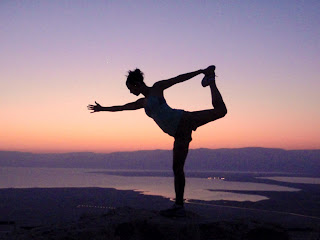
Sunrise yoga on Masada overlooking the Dead Sea
 My classmate Dan & I woke up around 4am to beat the heat & catch the sunrise atop the Masada plateau. The plateau rises 400 m above the Dead Sea and is prominent both geographically and historically.  With the stars still out I climbed the winding stairs in a dreamy state.  We were the first ones atop the plateau and wandered in silence through the ancient ruins as the colors of the sunrise began to shed light on the location.

   A little history (According to Roman Historians)*  When Herod the Great was named King of Judea by the Romans he was hated by his Jewish subjects and built up the natural fortress as a refuge between 37 and 31 BCE.  Herod was a master builder and transformed the fortress to include bath houses, palaces, store houses and cisterns. At the beginning of the First Jewish-Roman War in 66 CE, a group of Jewish rebels called the Sicarii overcame the Roman military post on Masada (70 years after Herod's death).  From a Roman refuge to a Jewish refuge, more Jewish families joined the group at Masada as they fled Jerusalem during the Great Jewish Revolt against the Romans.  This refuge was brief and in 72 CE the Romans laid siege to Masada.  The Roman legion set up camps around the plateau and built a giant siege ramp up to the top of the steep plateau.  The Romans finally breached the wall of the fortress - only to discover silence.....   The Jewish rebels (around 900) had decided to burn the fortress and end their own lives before they were taken alive and made slaves by the Roman legion.
    Because of this story, for many people Masada today represents the determination of the Jewish people against oppression.  A visit to the site has become something of a rite of passage for Jewish people and some Israeli Military even conduct their swearing-in ceremonies atop the fortress with an oath of 'Masada shall not fall again'.
      Due to the site's remoteness and desert climate it remained untouched for more than thirteen centuries until it was rediscovered in 1828!  It wasn't until the 1960's that the site had a thorough excavation and the fortress was preserved.  
Source: http://whc.unesco.org/en/list/1040


  The top of the plateau was absolutely breathtaking as we watched the sunrise over the Dead Sea.  It was amazing to walk through the old entranceways  and gaze down into the deep cisterns where they stored water for hundreds of people in the middle of a desert.  It was also interesting to reflect on the site as being so culturally significant to the Jewish people - and in many ways the Masada attitude of 'they'll never take us alive' seems to play into the hearts of many today, I suppose for better or for worse.
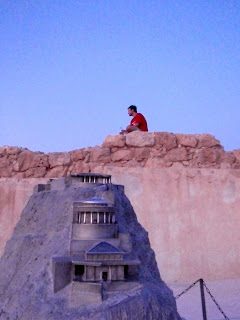
A model of the front of Masada - & Dan soaking up the view

On the second terrace below the top of the plateau - (refer back to the model pic)


A window looking out to the Judean Desert
The siege ramp that was built by the Romans
Looking down from the plateau you can see the remnants of the square Roman camp walls
(click image to make it bigger)
An ancient synagogue - According to the nearby museum, two pits dug in the back room of this area revealed  biblical scrolls
Dan on the walk down
looking back up from the base of Masada


To give a little bit more perspective this is an aerial of Masada - compliments of google images:)

Wednesday, June 29, 2011

Desert Oasis & Rapping Jews

The Oasis is a haven for desert birds & other wildlife
Desert Waterfalls:)
Ein Gedi is a picturesque nature reserve sandwiched between the Judean Desert and the Dead Sea - truly an oasis surrounded by barren landscape.  Thankfully this was an exception to desert hiking because we got a late start and did not arrive to Ein Gedi (spring of the Kid) until the afternoon- I was beginning to sweat before I even stepped off the bus just thinking about the desert heat. The first part of the trail was busy with many families and screaming kids..... thankfully as we continued on the trail it got steeper and hotter, successfully thinning out the crowd until only a handful persevered to the real treasures.... cool isolated pools and spectacular views.  This will be a short entry because I think the pictures say enough:)


 A natural window looking out to the Dead Sea
Taking a shower under the dripping ferns:)


Looking down to the Dead Sea & the various orchards - a true testament to 'making the desert bloom'
A look back at the mountain - framed with a date orchard
A bridge over a 'Wadi' (a dry ephemeral riverbed), a very common scene in Israel


Speaking of common scenes in Israel....... I move on to the famous rapping Jew - Matisyahu!!  
(side note- if you google rapping Jew the wikipedia site for Matisyahu is number 1)
Matisyahu - live in Jerusalem

When we saw that Matisyahu would be playing in the center of Jerusalem we knew it was an event we could not miss. He became popular around the world through his reggae beats and hip-hop beat-boxing..... but few people outside of the Jewish community (myself included) don't know his background or what he sings so passionately about.  This concert gave me the excuse to listen closer  and observe what really drew his followers in.

The concert was outdoors in a packed public square - and from the moment we walked in you could feel the high energy.  Some songs stuck out more than others as everyone sang them like they were songs that they had written themselves.  The song 'One Day' has become popular from its catchy tune - but listening closer you can hear an anthem of peace.  A couple of verses  from the song are as follows:  
all my life I've been waiting for
I've been praying for
for the people to say
that we don't wanna fight no more
they'll be no more wars
and our children will play
one day ...
one day this all will change
treat people the same
stop with the violence
down with the hate
one day we'll all be free
and proud to be
under the same sun
singing songs of freedom like
one day.... 

Now imagine that being sung as an anthem under the Jerusalem night sky by hundreds of young people that have grown up amongst violence, hatred and misunderstanding. After mandatory service in the military, many now search for a better way.....
 

Me, Patricia & Dan (two of my classmates) @ the concert


Sunday, June 26, 2011

Solidarity: Unity arising from common responsibilities ....

Representing the Palestinian Flag
      Like clockwork every Friday a diverse group of people young and old gather in East Jerusalem to stand up against civil inequality.  The foundation of this is due to the Israel government conducting forced evictions of Palestinian families from their homes in the Sheikh Jarrah neighborhood of East Jerusalem.  The demonstrations in the small neighborhood of Sheikh Jarrah have come to represent a greater political movement of the Israeli left and continues to draw people in due to its peaceful yet strong representation.

  A bit more background: During the 1948 Arab-Israeli war, Palestinians fled their homes in West Jerusalem and settled in East Jerusalem (which was ruled by Jordan at the time).  Many families waived their UN refugee cards in exchange for the right to build houses on the vacant lots in Sheikh Jarrah.  Then, in 1967 Israel gained occupation over East Jerusalem and the neighborhoods began to fill with Jewish settlers.  Currently different Jewish organizations have begun to claim ownership over the Palestinian land through Ottoman deeds that date back to the 19th century.  The Palestinian families have similar Ottoman deeds to homes in West Jerusalem but are not allowed to regain ownership.  There is an "Absentee Properties Law" that officially allows Jews to reclaim possession of prewar assets, but does not grant the Palestinians that equal right.

    We were on our way to the market on Friday when a large crowd on the corner drew our attention.  We found someone who spoke English and began to get pieces of a very involved and disputed story.  The woman was a middle-aged teacher from Haifa and turned out to be a great resource.  She was very passionate about the movement and standing up for equality but also admitted to becoming very disheartened over the years.  She had spent many years trying to make a difference through peaceful demonstrations but had only seen a continuation of injustice.  She reminded me of so many people back home who have fought hard for what they believed in, but then they got to a point where they also had to live a normal life.  It takes so much emotional and physical energy out of someone to go against the grain.  She said that when she begins to get down about the situation surrounding her she travels several hours to the Sheikh Jarrah demonstration to feel refreshed and revive the hope and passion towards a brighter future.  A major reason this movement continues is due to the energetic youth that are not giving up.  It stands as another reminder to me that although it may be easier to live your life in ignorance of heavy issues, it is important to stand for what you believe in.  The key as always is to find a balance within this so you keep a positive energy and don't burn out completely.

    As an observer I walked with the group of demonstrators through the disputed neighborhood, pausing in front of each of the houses where forced evictions occurred.  At some of the houses the Jewish Settlers came out to stand on their porches and rooftops, waving their Israeli flags and standing proud. At one house the Jewish Settlers even had speakers set up on their roof playing loud music to drown out the demonstrator's chanting.

    Because this demonstration is every Friday it is a very interesting dynamic - people get to know eachothers faces on both sides.  Many of the loudest voices on the demonstration side are the kids and adults that were evicted.  They yell with passion and in solidarity towards the houses that are now home to new families - which believe just as passionately about their right to be there.


The same guy has been arriving with the pirate flag for over a year - he has a strong grip on the pole as the Israeli flags aim to knock it..... I guess he feels that it is the most suitable flag to represent what is happening