Tuesday, August 2, 2011

Petra ~ Jordan


In front of the Treasury in Petra
    One of the most remarkable places in Jordan and also holding the prestige of one of the wonders of the world (on many lists:), the ancient rose-red city of Petra truly does take your breath away. The massive and elaborate rock-cut architecture is even more impressive standing next to than it is on the big screen with Indiana Jones (parts of 'The Last Crusade' were filmed here). Although it has become a popular tourist destination, the ancient city still holds local charm and wonder - without the artificial feel of other popular sites.  With an early start to the day it was easy to beat the crowds and wander silently through the canyons and winding pathways as the sun began to paint the rock with shades of red.


The majestic Treasury


A peak through the Siq to the Treasury


    The Siq is a narrow gorge that serves as the main entrance to Petra.  Besides the natural geologic beauty of this area, I was also amazed by the extensive water conduit system that ran along the inside of the Siq into the ancient city.  Considering the harsh desert that surrounds Petra is was an amazing feat to create an artificial oasis through the water system and effectively build up Petra to flourish and be one of the most important cities for the spice and silk routes from Asia over 2,000 years ago!

The Siq
A channel of the water system
Transportation through the Siq


* this was the cheesiest tourist thing but they actually did stop us...

The tombs set the background for the travelers on camels

   Petra has served as a sanctuary since ancient times ~ with the Nabataeans staking claim in the third century BC. The great ancient city was supposedly abandoned after several earthquakes destroyed infrastructure around AD 555, leaving the caves and ancient architecture to become the homes of the local Bedouin.  Currently the majority of the Bedouin live just outside Petra in a community the government made to draw them out of the caves in the newly deemed 'World Heritage Site'.  Besides the traditional pastoral lifestyle - the Bedouins now serve as the guides, craftsmen and shopkeepers of Petra.
Looking down on the caves that used to be home to hundreds


   I didn't know what to expect from Petra, but I was definitely happy to see that the red-rose city was not just one strip of historic architecture, but rather an entire landscape of hidden caves, towering cliffs and humbling desert.  You could easily spend a few days exploring the surrounding area, but unfortunately we had to squeeze every last drop out of one full hot day.
The 'High Place of Sacrifice'

A view of the stadium and more caves

The natural beauty of the rock mixed with the man-made entrance

Looking down on the tombs carved into the side of the canyon walls (you really have to enlarge this one to see it)
A picturesque resting place
Our Petra Group- We met a fun couple from Belgium at the place we were staying


The Monastery
    One of the longest hikes and best rewards was to the Monastery of Petra. At close to 50m high it towers above you, and really makes you wonder how on earth they were able to carve out such a spectacular piece of architecture over 2,000 years ago.  The Monastery and it's backdrop seemed very surreal, like someone had sketched it onto the desert landscape.

View from above the Monastery

A view of the harsh yet stunning Jordan landscape

Bedouin women sweeping in front of her shop


Ancient temple area
    So I thought I would start out with Petra because it was the most spectacular and the most memorable part of Jordan....... but there was also the element of getting there in the first place.  First of all we had over five hours of travel by bus from Jerusalem to Aqaba - and once we arrived in Aqaba we were officially ready for the weekend.  We dropped our bags and went out to dinner - sampling some of Jordan's finest beer.  I ordered the Petra beer thinking it would be a nice micro-brew, little did I know that I was in for a stiff malt liquor in a tall can that looked oddly close to the Coors can.  Although seemingly worlds apart, 'a taste of the red-rose city' was not too much unlike 'a taste of the Rockies'.  After that strong start we ended up having a fun night out on the town full of darts, billiards and beer.  
The local cans:)
       The next morning was not as early as we had hoped - and once we stepped out of the door it was already extremely hot.  We did not exactly have a set plan so we decided it would be a good idea to go find some water to play in.  We had heard of Wadi Mujib nature reserve before and somehow had the idea that it was only a few hours north, so we hopped in a shared cab headed in that direction.  Our destination was a small town called Karak where we were supposed to find another ride to the nature reserve.  The further we went north, the less tourists there were which also equaled less people speaking English.  Although the people in our cab spoke limited English, we pointed out where we wanted to go on a map and they wrote down the remainder of our itinerary and destination in Arabic (for us to show people).  We wandered around a bit in Karak where we were dropped off - trying to tell people we wanted to go to Wadi Mujib and showing them the Arabic writing we were given.  People were extremely friendly and it seemed like everyone tried to get together to help us.  Soon we were on a small mini-bus headed for Wadi Mujib.  The mini-bus was initially full of people, but then after about 45 min we found that we were the only ones on the bus and it was no longer picking people up.  There was one bus driver, a fare collector and a friend up front and then Dan & I in the back surrounded by empty seats.  
      Not really having a clue where we were, we just kept on repeating Wadi Mujib and they repeated it back and smiled.  Before we knew it we had traversed down a steep and windy road and had arrived at a major dam..... the dam of Wadi Mujib.  After trying to use charades to show that I wanted to hike and go swimming at a nature reserve, it was pretty obvious that there had been some miscommunication.  We walked into the dam authority building to try and find someone who spoke English and ended up finding out that we were on the opposite side of where we wanted to be.  The miscommunication was because Wadi Mujib to them is the entire valley - whereas we wanted the Wadi Mujib Nature Reserve.  Our slightly lazy minds from the night before were not the most proactive that day and unfortunately we had relied on what our first ride had wrote in Arabic.... thinking that after pointing it out on a map it would be our easy ticket to successful travel.  So in the end we spent pretty much the whole day traveling - jumping from bus to taxi to bus, sweating from the extreme heat and playing charades to make up for our language barriers.  It was a bit frustrating and more costly than we had hoped - but it also held many good lessons and gave us a glimpse of the everyday life of the locals off the beaten track.  Their efforts to try and help were warm and always friendly - and I only wish we had more time in the country..... to get lost without counting the hours:) 

View of the reservoir at Wadi Mujib

Wednesday, July 20, 2011

Desert Life


“Strolling on, it seems to me that the strangeness and wonder of existence are emphasized here, in the desert, by the comparative sparsity of the flora and fauna: life not crowded upon life as in other places but scattered abroad in spareness and simplicity, with a generous gift of space for each herb and bush and tree, each stem of grass, so that the living organism stands out bold and brave and vivid against the lifeless sand and barren rock. The extreme clarity of the desert light is equaled by the extreme individuation of desert life-forms." - Edward Abbey

Swinging into the sunset
I have always been fascinated by desert environments & I think Abbey sums it up well in his description of the desert's simplicity.  Hiking in the desert brings a person back to this beautiful simplicity.  Being exposed to the elements you rise with the sun to take advantage of the cool morning air and follow your instincts from there..... Hiking in the stillness it seems as though the world is either at macro or micro scale and our human scale is close to non-existent to the world around us - we are only an observer.  The macro scale is in the vast open spaces - seeing for miles away and gazing at massive geological wonders.  The micro scale is beneath our feet - all of the creatures have adapted to be small and/or camouflaged and the true treasures such as ancient tiny seashells stand out like diamonds amongst the red sand.  Sometimes it is not cool water, shade or the music of a busy life that is the most refreshing - Instead, it is the thirst, the dry heat and only the sounds of our footsteps and heartbeat that bring us back to life.

Lounging Ibex
Early morning start for the desert hike...
Stairs up the canyon wall


looking out from one of the caves along the cliff that monks used to dwell in
     

The group of classmates and friends that we stayed with in Sde Boker - a small university community within the Negev

Bedouin Tent
         A note about the Bedouin of the Negev.... The term 'Bedouin' literally means desert dweller in Arabic and continues to represent the last group of nomads in the region.  The Negev desert is estimated to be home to around 150,000 Bedouins, most of which live in 'unrecognized' villages.  The Bedouin encampments seem to be just another trouble on the Israeli government's long list.  The government has passed laws restricting the Bedouins nomadic lifestyle by not permitting grazing and establishing private ownership and borders to the seemingly desolate terrain. The goats were their major source of livelihood and without their herds they lack the goat hair to weave their rugs and tents as well as food for their families.  Now the encampments are comprised of everything and anything they can find from pieces of plastic to old lumber. The government has also attempted to resettle the Bedouins into constructed 'legal' towns (many times by bulldozing their seemingly temporary establishments) - but a circle of buildings does not make a community and with no business or economy the Bedouins are struggling and the towns are failing.  Many Bedouins in 'unrecognized' encampments have begun small tourist initiatives by providing tea and pita to passing travelers (such as the tent seen in the pictures).

Relaxin' in the Bedouin tent

Wednesday, July 13, 2011

Sweet Water


The consistent wind is the only relief from the hot furnace of the day
    The question of fresh water, also known as 'sweet water' in Israel, has become my ticket into the lives of many people around me and the lens through which I view their personal stories of passion, fear, hatred, love, exhaustion & hope.  I recently traveled to a small village outside of Jericho, one of the world's oldest cities, to hear personal stories & see how steps towards peace and sustainability could be made through water.


    It has become increasingly evident that the government (on both sides)  has continued to foster distrust and obstructed many of the possibilities for cooperation as they are caught up in conflict and inaction.  However, where governments are failing, civil-society is standing up to give a voice to the degrading environment and the social stress that is deeply rooted in the health of the natural world around them.  The water scarcity issues are inherently transboundary and as civil-society comes to the forefront, cooperation is emerging and sustainable solutions are giving hope.

    One of the groups that has survived the test of time and conflict in the area is Friends of the Earth Middle East (FOEME).  FOEME remains one of the only joint Israeli-Palestinian organizations engaged in transboundary water issues.  'Joint' is the key word here - for it is extremely uncommon!  In order to work with one another you have to recognize the existence of the 'other'.  In most cases, even seemingly contemporary and sincere environmental and social NGO's refuse to work jointly - with the perspective that they are not against the other side but not exactly for the other side either.
    So, knowing a bit of background on FOEME I decided to seek out a way to connect with them and see how they overcome tense political agendas with environmental education and transboundary cooperation. Long story short, I decided the best introduction for me would be to visit one of their new 'Eco-Centers' that was located in Auja, just north of Jericho (also known as West Bank's 'Area B').
    Myself and two friends (Dan & Eric) arrived to Auja in the heat of the day (which meant between 8am and 5pm here); dripping in sweat we were warmly greeted by the contacts I had made at the center and then told nothing could be done/discussed until  it cooled down - which was fine by me as a siesta was calling my name.

Auja Eco-Center
    As the sun was beginning to set we were first given a tour of the Eco-Center grounds.  The area was colorfully decorated with recycled tires to form pathways, lounging areas, and a playground.  The best part about the center was its grey-water system which was made up of a series of open plastic containers filled with an assortment of rocks, plants and sand of which the water from the center (from showers, kitchen/bathroom sinks etc) is filtered through and then used to water the small gardens.

Grey-water system
     After the center tour, our guide Mohanned led us through the neighborhoods and into the surrounding farmland.  It was a treat to have Mohanned because he had grown up in Auja (a small village of around 5,000) and knew pretty much everyone.  He has 15 siblings and over 60 cousins in Auja so not only did he know everyone - almost everyone we met was his cousin, so every story he told was a personal family story.  
    I will try and sum up the water situation in Auja as brief as possible from the perspective given to us by those that live there.  Auja is located in the Jordan Valley which was once known for being full of springs and very fertile. Mohanned reflected on his time growing up when the fields were full of banana trees and date palms - a bountiful time for the Jordan Valley.   Unfortunately the picture now is the extreme opposite with no water in sight and only dust in the fields.  The lack of water can be primarily attributed to two factors - 1. An extended drought period & 2. The water usage of recently established Jewish settlements. 
    The primary water source for Auja is the groundwater which provides flow for local wells and springs.  Surface water is pretty much nonexistent because the Palestinians have been denied access to the Jordan River (about 4 km away) since 1967. Although it should also be noted that even if there was access to the Jordan river, it would not sufficiently provide for the communities needs because it is more of a toxic stream - having lost more than 90% of its normal flow in the last five decades it has been used and abused. *side note* The river is fenced off so you can't even see it on the Palestinian side.  One man was telling us about his family's land that used to be along the shore of the Jordan River & now he says the only way he can see it is through 'google earth'!
    The main spring that supplied the community was Auja spring.  The spring was the lifeline of the entire community as the canals from the spring brought water for agriculture and everyday usage.  The community has not seen water from the spring in two years and today the empty canals are filled with trash and are a heartbreaking reminder of days past.
Auja spring canal
     There are three Jewish settlements around Auja - with their green yards and plentiful fields they are in sharp contrast to the surrounding dry village.  The settlements are allowed to utilize the groundwater unconstrained and have drilled several very deep wells, sufficiently dropping the water table.  On the other hand, the Palestinians are not allowed to drill new wells or rehabilitate old ones without permits from the Israel Authority (which seem to be seldom given).  There are about seven wells that are left to service the entire Auja community and its agriculture.  These wells are mostly privately owned and are restricted in use (the Israel Authority comes once a month to check the status of the well - if they think too much water has been withdrawn then they will decommission the well).  On top of this - many of the wells are being over-exploited and are suffering from saltwater intrusion. 

One of the remaining private wells in Auja
A decommissioned well next to a dry canal
    At the end of the day, most families have to purchase their water from tankers and resort to buying bottled water for drinking - both of which can be up to 8 times the cost of the groundwater.  Also, without water the people in the community have lost their agricultural livelihoods & without additional work skills they have no choice but to work for the settlements at very low wages. One man we spoke to had to give up his family farm and work on a settlers farm instead - he looked physically and emotionally exhausted as he spoke of the settler's safe haven of swimming pools and running irrigation - his voice still echoes in his statement, "How did I become a second class citizen on my own land?".....
       I don't fully understand both sides of the situation, nor will I ever - but I can say that I do strongly oppose the settlements. *I will leave it at that for now*

An abandoned field - the plastic remains were a last effort to capture the remaining soil moisture - 


Now the plastic only litters the dry landscape
    On a positive note, the signs of the Eco-centers existence were shining through the dusty haze of the village as Mohhaned pointed out places where they had helped install grey-water systems, solar energy and rain-catchment systems into the community.  Instead of throwing their hands up to the sky in vain and dwelling on the tense political situation, FOEME has taken bold steps towards the realities of the water scarcity situation by encouraging saving, reusing and sustainable water practices within the community.  
   I felt heartbroken and a bit enraged observing the Auja water situation and knowing it was only one of many stories.  But, it is only a waste of time to place blame - even if the injustice is palpable. For the communities that seem powerless, the power lies within their ability to innovate and deal with existing conditions - working in the present to meet the future.
Lounging on one of the center's recycled benches

Sunday, July 3, 2011

Masada

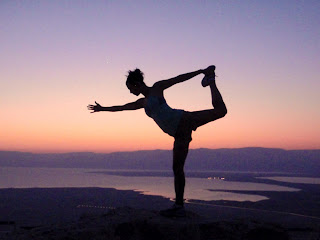
Sunrise yoga on Masada overlooking the Dead Sea
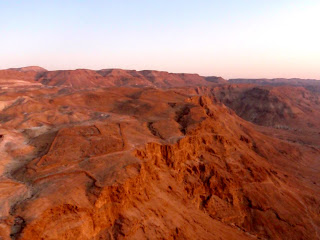
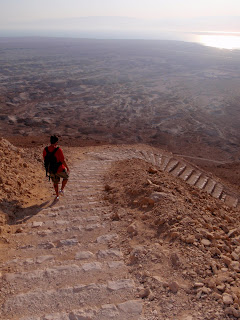
 My classmate Dan & I woke up around 4am to beat the heat & catch the sunrise atop the Masada plateau. The plateau rises 400 m above the Dead Sea and is prominent both geographically and historically.  With the stars still out I climbed the winding stairs in a dreamy state.  We were the first ones atop the plateau and wandered in silence through the ancient ruins as the colors of the sunrise began to shed light on the location.

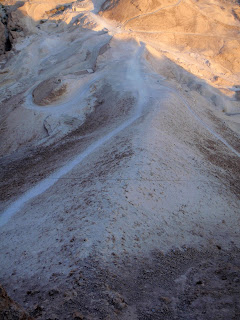
   A little history (According to Roman Historians)*  When Herod the Great was named King of Judea by the Romans he was hated by his Jewish subjects and built up the natural fortress as a refuge between 37 and 31 BCE.  Herod was a master builder and transformed the fortress to include bath houses, palaces, store houses and cisterns. At the beginning of the First Jewish-Roman War in 66 CE, a group of Jewish rebels called the Sicarii overcame the Roman military post on Masada (70 years after Herod's death).  From a Roman refuge to a Jewish refuge, more Jewish families joined the group at Masada as they fled Jerusalem during the Great Jewish Revolt against the Romans.  This refuge was brief and in 72 CE the Romans laid siege to Masada.  The Roman legion set up camps around the plateau and built a giant siege ramp up to the top of the steep plateau.  The Romans finally breached the wall of the fortress - only to discover silence.....   The Jewish rebels (around 900) had decided to burn the fortress and end their own lives before they were taken alive and made slaves by the Roman legion.
    Because of this story, for many people Masada today represents the determination of the Jewish people against oppression.  A visit to the site has become something of a rite of passage for Jewish people and some Israeli Military even conduct their swearing-in ceremonies atop the fortress with an oath of 'Masada shall not fall again'.
      Due to the site's remoteness and desert climate it remained untouched for more than thirteen centuries until it was rediscovered in 1828!  It wasn't until the 1960's that the site had a thorough excavation and the fortress was preserved.  
Source: http://whc.unesco.org/en/list/1040


  The top of the plateau was absolutely breathtaking as we watched the sunrise over the Dead Sea.  It was amazing to walk through the old entranceways  and gaze down into the deep cisterns where they stored water for hundreds of people in the middle of a desert.  It was also interesting to reflect on the site as being so culturally significant to the Jewish people - and in many ways the Masada attitude of 'they'll never take us alive' seems to play into the hearts of many today, I suppose for better or for worse.
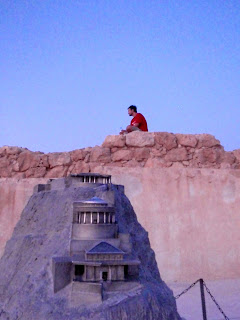
A model of the front of Masada - & Dan soaking up the view

On the second terrace below the top of the plateau - (refer back to the model pic)


A window looking out to the Judean Desert
The siege ramp that was built by the Romans
Looking down from the plateau you can see the remnants of the square Roman camp walls
(click image to make it bigger)
An ancient synagogue - According to the nearby museum, two pits dug in the back room of this area revealed  biblical scrolls
Dan on the walk down
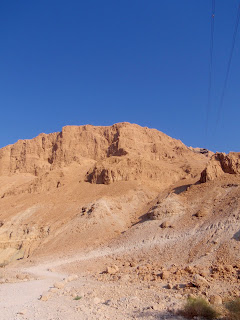
looking back up from the base of Masada


To give a little bit more perspective this is an aerial of Masada - compliments of google images:)